


Choosing an Accredited Vocational School Matters
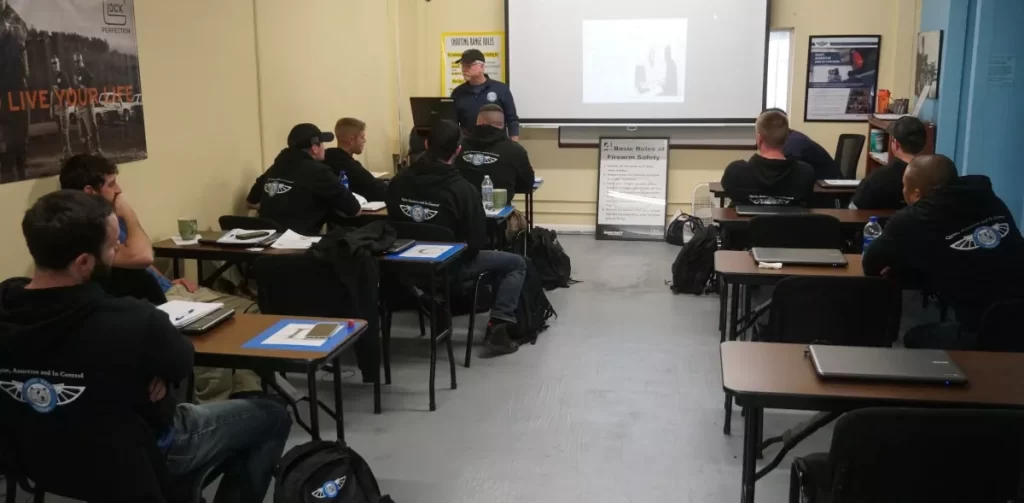
Choosing an Accredited Vocational School Matters
In general, an accredited vocational or trade school ensures that the training programs offered meet the highest national standards in terms of curriculum, instructional design, and faculty expertise. These are essentially schools and programs alternative, but of equal caliber, to traditional higher education colleges and universities.
Choosing an accredited vocational school not only guarantees that students receive the best training, but it also provides a clear benchmark for employee development in the future. In the security industry, that’s Pacific West Academy; a trailblazer in the fundamental education of security professionals throughout the nation.
One of the key benefits of training security professionals at recognized and accredited institutions is the exposure to a broader range of experiences and perspectives. Students at PWA are taught by instructors from a variety of backgrounds, with a plethora of experience and intelligence under their belt. Working with PWA instructors exemplifies to students how to lead, maneuver, and control in what can sometimes be very intense environments.
Accredited training schools and academies are recognized by employers and industry regulators as institutions that offer a high-quality education. This recognition translates to better job prospects, higher salaries, and a competitive edge in the job market. Confident security professionals who possess the knowledge and skills required to excel in their roles add significant value to their organization, which translates to a prosperous and successful business. Frankly, properly trained executive security agents make clients and crowds feel safe.
Choosing to pursue your security training at an accredited institution is the first step to competing and getting placed in a role within the security industry. Not only will you be properly equipped for any security-based role due to vetted curriculum and instructors, but you’ll have a higher-caliber of credibility from the start of your career.
Interested in kickstarting your career in security or executive protection? Contact Pacific West Academy to find what works for you.
At Pacific West Academy, our executive protection training program approaches CQB not as a set of pre-rehearsed actions, but as a cognitive skill set. It’s a thinking game, and the ultimate goal is not just to win a gunfight, but to dominate the battlespace through superior information processing. This article breaks down our unique philosophy, moving beyond the myths to show you what truly effective CQB looks like in a professional bodyguard training context.
The Foundation: Separating Marksmanship from Tactics
Before we can even discuss tactics, we must address the fundamental skill of shooting. CQB is a theory and a tactic, but shooting is simply shooting. We believe these two skills must be trained separately before they can be effectively integrated.
Why this separation? An elite competition shooter with no tactical experience can learn CQB relatively quickly because their weapon handling and accuracy are already second nature. Conversely, an operator who knows all the tactics but struggles with marksmanship will find it much harder to get up to speed, but will have better tools to handle any emergency. Our executive protection school builds its curriculum on this principle: master the firearm first, so you can dedicate your mental bandwidth to tactics when it matters most.
The Core Concept: CQB as Information Dominance
The central pillar of our CQB philosophy is this: Controlling the amount of information you gain, maintain, or lose within an enclosed space. Forget complex choreography; success in CQB is about managing what your senses are processing. “Information” is anything and everything you can perceive in the environment.
What constitutes information in a tactical environment?
- What you see: Threats, exits, light, darkness, obstacles, shell casings, blood, and shadows.
- What you feel: The temperature of a room, something underfoot like blood, or the distinct tactile feedback of your slide locking to the rear—a stimulus that tells you to reload.
- What you hear: Talking, walking, screaming, or bangs.
Your goal is to intake all this data and make an educated decision based on it. To manage this flow, we teach three primary solutions:
- To Gain Information: You must start “pying” or methodically clearing angles.
- To Maintain Information: If you see a certain amount of a room and don’t want to gain or lose anything, you either hold your position or move in a straight line to adjust your distance without changing your angle.
- To Lose Information: This is a deliberate trade-off. You only give up information on one area to gain more valuable information on another. An example is clearing a center-fed room; you must lose sight of one side to fully clear the other.
The Geometry of Survival: Correcting a Fatal CQB Flaw
One of the most common and dangerous mistakes we see is using the center of a doorway as a pivot point. When an operator does this, their line of sight arcs through the room, but their body becomes exposed to un-cleared areas long before they can see them. We’ve seen this lead to operators being late to the gunfight—turning to engage a threat they’ve been exposed to for critical seconds.
This method is a no-go in our training.
The solution is to change your axis of rotation. Instead of pivoting on the threshold, you use the nearest wall of the entryway as your axis. By “pying” off this near wall, you remain concealed from every part of the room you haven’t yet cleared. You slice the room into small, manageable pieces, processing information all the way until you reach the point of entry. This isn’t some esoteric tactic; it’s the fundamental principle of shooting from a barricade.
Context is Key: Adapting CQB for Close Protection Training
Military CQB tactics are often designed for a team. The goal of “flowing” into a room is to get as many guns in the fight as possible, with each operator responsible for only a small 15% slice of the room. This method is built for speed and overwhelming force, but it comes at a cost. The first person through the door faces a notoriously high mortality rate—as high as 87%, according to instructor cadres.
In executive protection, you are often the only one. There are no six dudes behind you to take up the slack. Rushing to your death isn’t an option.
Furthermore, your objective is different. In the military, the mission was to take over the building, clearing every single room. In EP, if you have your client, your primary duty may be to barricade yourselves and wait for law enforcement. If an active shooter is present, your goal might be to simply draw their attention to yourself to keep them from shooting anyone else, a psychological tactic to protect others. The context of your close protection certification dictates a more deliberate and thoughtful approach.
Pace and Precision: The Hasty vs. Deliberate Method
Because context is everything, operators must be able to control their tempo. We teach two modes: hasty and deliberate.
- Deliberate: This is a slower, safer method that allows you to take the time to process small bits of information. The closer you get to a known threat or “indication,” the more deliberate you become.
- Hasty: A faster technique, you gain information quickly, but take on more risk. This is used when dealing with “maybes” on the way to a known threat. If you hear shooting down a long hallway, you’re not going to deliberately pie every open door along the way; you’re going to move hastily toward the indication to engage.
The Gateway to Danger: A Smarter Approach to Doors
Doors are one of the most dangerous thresholds. Our bodyguard school teaches a specific, methodical process for handling them.
- Classification: First, understand what you’re dealing with. We simplify it to four types: push, pull, lift, and slide. For most structures, you’ll face push or pull doors. You can tell the difference by looking for the hinges; if you can’t see them, it’s a push door.
- Easy Side vs. Hard Side: The “easy side” is the side with the doorknob; the “hard side” is the hinge side. You always want to work from the easy side if possible. Opening a door from the hard side exposes you in the fatal funnel of the doorway for a dangerously long time.
- Let the Room Breathe: Before you commit to opening a door, check if it’s unlocked. A quiet turn of the handle tells you if the door is free-floating. After confirming it’s unlocked, back off the door. This prevents you from being right in front of it if someone decides to shoot through it. This small step avoids the loud mistake of trying to kick or ram a door that was simply locked with a deadbolt.
- Weapon Position: When manipulating a doorknob, your weapon should be positioned to deliver effective shots to a high-thoracic region on an average-sized male. It should be in a structured, single-handed position that allows for immediate, accurate fire if necessary.
Conclusion: Earn Your Bodyguard Certification with Real-World Skills
Effective CQB isn’t about looking cool or replicating military tactics without understanding their context. It’s about managing information, controlling your exposure, and making smart decisions under pressure. It’s a skill set that must be adapted for the unique challenges of the executive protection field, where you are often a solo operator whose primary duty is defense and client safety.
Ready to move beyond the Hollywood version of close protection? Explore our executive protection training courses and earn your certification with instructors who prioritize what actually works.
BLOG
TESTIMONIALS
What Our Students Say
REQUEST MORE INFO
Want To Know More?
Get in touch with us to get more information about our Executive Protection Training Programs or to ask us a specific question you weren’t able to find the answer to on our website.
We’re here to help you.